
Ursolic acid prevents doxorubicin‐induced cardiac toxicity in mice through eNOS activation and inhibition of eNOS uncoupling
Haiman Mu1,2, Haiwen Liu1, Jiayi Zhang1, Jianhua Huang1,3, Chen Zhu 1,2, Yue Lu2, Yueping Shi1, Yi Wang1
System Used:
Prospect T2

Doxorubicin is a frontline chemotherapy, but its cardiotoxicity can limit the very patients it’s meant to save. This study investigates how ursolic acid protects against doxorubicin-induced cardiac injury, using high-frequency echocardiography with the Prospect high-frequency ultrasound system to non-invasively track cardiac function in mice.
Ursolic Acid as a Cardioprotective Agent Against Doxorubicin-Induced Toxicity
In addition to the known antitumour effects of ursolic acid (UA), increasing evidence indicates that this molecule plays a role in cardiac protection. In this study, the effects of ursolic acid on the heart in mice treated with doxorubicin (DOX) were assessed.
Ursolic Acid Improves Cardiac Function and Reduces Oxidative Stress
The results showed that ursolic acid improved left ventrical fractional shortening (LVFS) and left ventrical ejection fraction (LVEF) of the heart, increased nitrogen oxide (NO) levels, inhibited reactive oxygen species (ROS) production and decreased cardiac apoptosis in mice treated with doxorubicin. Mechanistically, ursolic acid increased AKT and endothelial nitric‐oxide synthase (eNOS) phosphorylation levels, and enhanced eNOS expression, while inhibiting doxorubicin-induced eNOS uncoupling through NADPH oxidase 4 (NOX4) down‐regulation.
A Potential Therapeutic Agent for Doxorubicin-Associated Cardiotoxicity
These effects of ursolic acid resulted in heart protection from doxorubicin‐induced injury. Therefore, ursolic acid may be considered a potential therapeutic agent for doxorubicin associated cardiac toxicity in clinical practice.
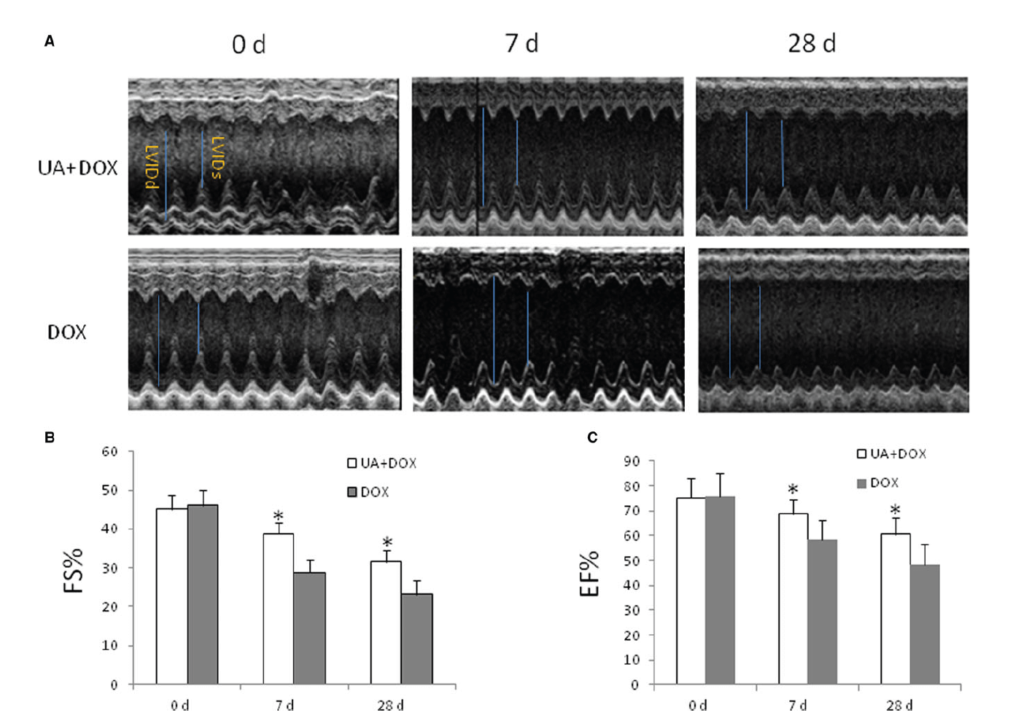
FIGURE 1 Ursolic acid preserves cardiac function in mice treated with doxorubicin in both early and late injury phases. A, Heart echocardiography. Upper panel, Doxorubicin + Ursolic acid group (UA + DOX); lower panel, Doxorubicin group (DOX). LVIDd, left ventricle internal diameter in diastole; LVIDs, left ventricle internal diameter in systole. B, Ursolic acid treatment significantly improved FS at both 7 and 28 days, compared with the Doxorubicin control group (n = 5, *P < 0.05). C, Ursolic acid significantly improved EF at both 7 and 28 days, compared with the doxorubicin control (n = 5, *P < 0.05)
Learn More About the System Used in this Study
Cardiac function was tracked non-invasively across early and late injury phases by high-frequency echocardiography on the Prospect T1 (Now Prospect T2), the kind of serial, in vivo imaging that makes longitudinal cardio-oncology studies possible.