
(February 25, 2026) Webinar: How to Optimize Your Western Blot Workflow and Choose Between Epi-Fluorescence vs. Chemiluminescence
Overview:
This session is ideal for anyone who runs Western blots often, is chasing clearer signals, or wants to make their data more quantitative.
Western blotting is one of the most widely used methods for protein analysis, but many researchers still struggle with:
- Weak or inconsistent bands
- Noisy backgrounds
- Limited dynamic range
- Poor quantification confidence
These problems often aren’t just about sample prep and usually come down to how the blot is imaged.
In this webinar, we showed how modern imaging tools can improve data quality, reproducibility, and quantification. We also demonstrated how to optimize your western blot workflow using Vilber’s FUSION Absolute, from sample preparation through detection, with a practical focus on imaging strategies that deliver reliable, publication-ready results.
We then explored epi-fluorescence detection as a powerful alternative, highlighting its stable signal over time, wide dynamic range, and multiplexing capabilities. Attendees gained a clear understanding of how fluorescence differs from chemiluminescence and how to resolve imaging-specific issues like channel crosstalk and background noise.
The webinar concluded with practical guidance on choosing the right imaging system to match your research needs, showing how modern multimodal imagers, such as the FUSION Absolute, enable flexibility, sensitivity, and confidence across both chemiluminescent and fluorescent western blot applications.
Key Learning Objectives:
- Where most Western blot workflows lose sensitivity
- When chemiluminescence still makes sense
- When epi-fluorescence provides a major advantage
- How to reduce saturation and improve linear quantitation
- Examples of optimized imaging strategies
You can also view how the next‑generation imaging systems help achieve:
- Higher signal‑to‑noise detection
- More accurate quantification
- Better reproducibility across experiments
Watch Our Recorded Virtual Workshop & Presentation
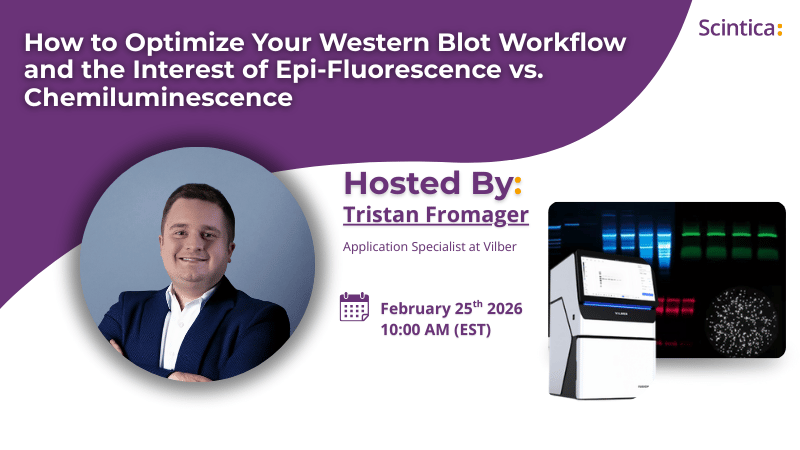
About the Speaker

Tristan Fromager is a sales engineer in biotechnology and chemistry, specializing in imaging applied to life sciences. He has been working at Vilber for over 4 years, a French company specialized in imaging solutions for molecular biology.
He supports researchers and laboratories by providing solutions to optimize their results, particularly for agarose gel and Western blot imaging. His technical expertise enables him to translate scientific needs into concrete and reproducible solutions.