Publication Highlight: Non-Invasive Real-Time Pulsed Doppler Assessment of Blood Flow in Mouse Ophthalmic Artery
Publication Highlight: Non-Invasive Real-Time Pulsed Doppler Assessment of Blood Flow in Mouse Ophthalmic
Overview:
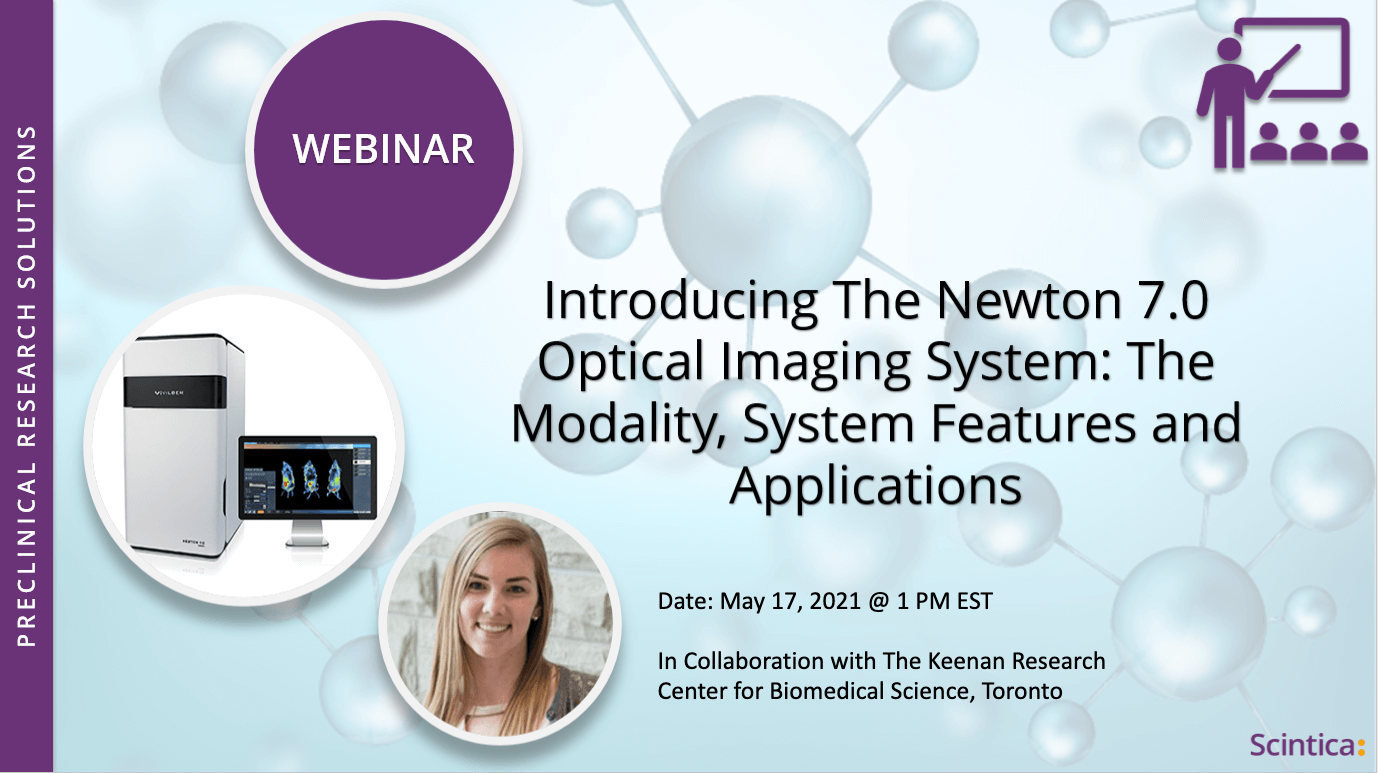
In this webinar, Katie will review how optical imaging works and provide some common examples of how it’s used within preclinical research. She will then introduce the Newton 7.0 FT500, an optical imaging system manufactured by Vilber that includes bioluminescence, fluorescence, and 3D tomography capabilities. She will end the webinar by going through some of the most common questions/considerations that come up for those looking to add optical imaging capabilities to their lab.
The Newton 7.0 is a highly sensitive optical imaging system dedicated to preclinical imaging of small animals in vivo, and may also be used on a variety of in vitro and ex vivo samples. It combines the best optics and animal handling features for high-quality image data and quantification. The Newton 7.0 system is capable of bioluminescence, fluorescence as well as 3D tomographic imaging.
The system is:
Whether you are just exploring the idea of adding optical capabilities to your lab or you’ve been imaging for years, you won’t want to miss the opportunity to learn about this cool new technology and ask questions about your specific research applications and study design.
Learning objectives:
In collaboration with The Keenan Research Center for Biomedical Science, Toronto
Publication Highlight: Non-Invasive Real-Time Pulsed Doppler Assessment of Blood Flow in Mouse Ophthalmic
Article Highlight: Intravital Imaging of Cardiac Tissue Utilizing Tissue-Stabilized Heart Window Chamber in
Article Review: New Approach Methodologies (NAMs) Therapeutic Efficacy of Human Skin Equivalents Fabricated
Application Highlight: Studying Coronary Vessel Dynamics The coronary vessel wall plays a central
Publication Highlight: Human Articular Chondrocytes Retain Their Phenotype in Sustained Hypoxia While Normoxia
Publication Highlight: Small Arteries From Old Spontaneously Hypertensive Rats Exhibit Enhanced Endothelium-Independent Vasodilatory