Publication Highlight: Long-Term Optical Imaging Reveals Bone Marrow Clearance and Extramedullary Escape in BCMA CAR-NK Therapy
Shelby Kaczmarek, Donghyeon Jo, Safa Ghaziasgar, Bryan Marr, Stefania Berton, Lisheng Wang, Mehdi Arbabi Ghahroudi, Mihue Jang, Alissa Visram, Scott McComb, Seung-Hwan Lee
Background
Multiple myeloma (MM) is an aggressive plasma cell malignancy that mostly resides in the bone marrow. Chimeric antigen receptor (Car-T) cell therapies targeting B-cell maturation antigen (BCMA) have revolutionized MM treatment, but widespread use is limited due to their high cost and complex manufacturing. These limitations have increased the interest in allogeneic therapies, which use immune cells derived from healthy donors. In this context, natural killer (NK) cells engineered to express BCMA-directed CARs may potentially be a promising alternative, particularly when combined with IL-15 to enhance persistence and function. In this study, the authors investigated the short- and long-term efficacy of α-BCMA-CAR NK cells with IL-15 co-expression in a xenograft mouse model of MM.
Key Findings
IL-15 co-expression improved NK cell persistence and anti-myeloma activity.
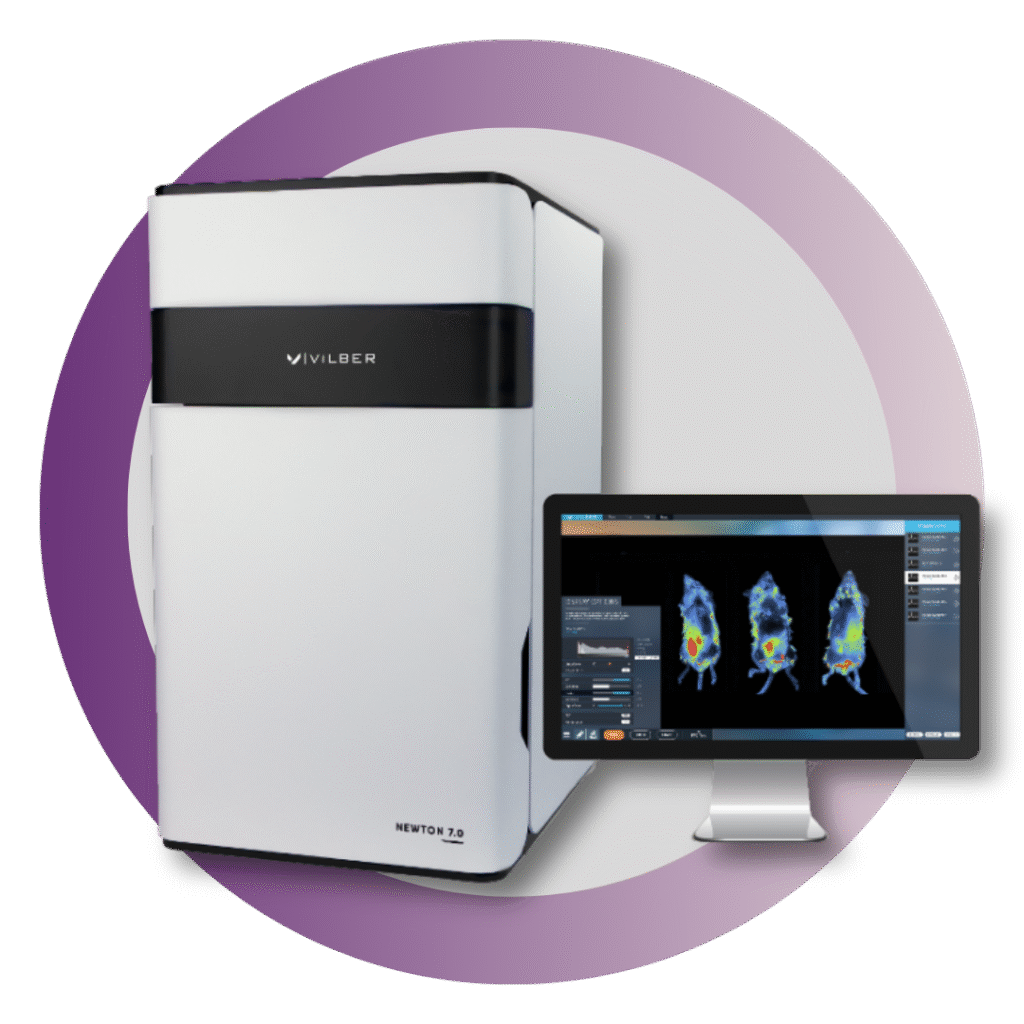
Mice with luciferase-expressing MM cells were monitored using the Newton 7.0 FT500 for bioluminescent (BLI) imaging following CAR-NK treatment. MM growth was mitigated when both CAR and IL-15 were administered.
Whole-body BLI imaging was performed weekly to evaluate long-term disease control. Although tumor clearance in the bone marrow was maintained, localized tumors developed at later time points.
Optical imaging-guided necropsy was used to examine mechanisms of immune escape. The tumors remained BCMA-positive but showed minimal NK cell infiltration, suggesting the resistance was driven by the tumor microenvironment, rather than antigen loss.
Conclusions and Next Steps
This study established that NK cells expressing α-BCMA-CAR with IL-15 effectively controlled MM, prolonging survival in a preclinical model. However, long-term optical imaging uncovered the consistent emergence of extramedullary disease, a clinically relevant relapse pattern that would have been missed with short-term endpoints.
Product Highlight
The Newton 7.0 FT500 played a critical role in this study by enabling high-sensitivity, longitudinal BLI of myeloma progression. Its signal detection and spatial resolution capabilities helped to distinguish bone marrow-localized disease from emerging extramedullary tumors. Additionally, long-term imaging made it possible to capture late-stage relapse events.