
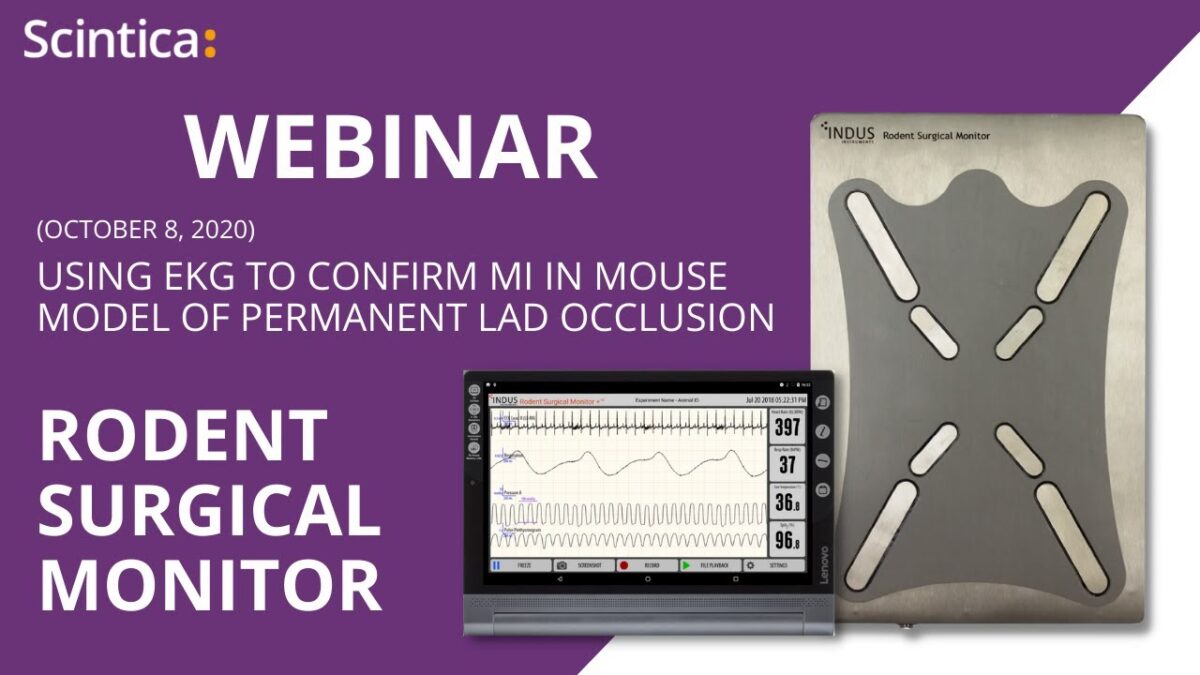
(October 8, 2020) WEBINAR: Using EKG to Confirm MI in Mouse Model of Permanent LAD Occlusion
The mechanisms involved in the progression of heart failure includes cardiomyocyte death, initiation of the inflammatory response, and subsequent formation of a fibrotic scar. For this reason, diverse experimental models, such as cultured cardiac cells, isolated hearts, and animal models, have been created to mimic human myocardial infarction and heart failure. In a 2012 Scientific Statement from the American Heart Association, permanent coronary artery ligation was deemed clinically relevant and a significant model for ischemic heart failure.
The variability in coronary artery anatomy and branching of the left coronary artery can affect reproducibility of MI surgery, even with occlusion at a constant anatomic site. Blanching and LV discoloration are common variables used to confirm successful MI surgery. Determining a way to improve precision will improve the standard surgical approaches to simulate MI in mice, thus reducing the number of experimental animals necessary for statistically relevant studies. In this webinar, we discussed the advantages of using electrocardiography to verify correct ligation.
Learning objections
- Summary of my lab goals
- Timeline of inflammation after permanent occlusion
- Intro to MI surgical model
- EKG measurement (changes before and after MI)
About the Speaker (s)

Kristine DeLeon-Pennell, Ph.D.
Assistant Professor, Department of Medicine Medical University of South Carolina
Dr. DeLeon-Pennell was trained in cardiovascular sciences at Baylor University, University of Texas Health Science Center San Antonio, and the University of Mississippi Medical Center. She has >10 years’ experience with all aspects of the inflammatory and fibrotic components of cardiac remodeling following a heart attack. Her current research projects focus on the role of the adaptive immune system and how it interplay with the innate immune system to regulate cardiac wound healing. This includes evaluating how existing confounding variables such as gender or aging changes these processes.