[For Immediate Release | Publish Date: July 22, 2026 ]
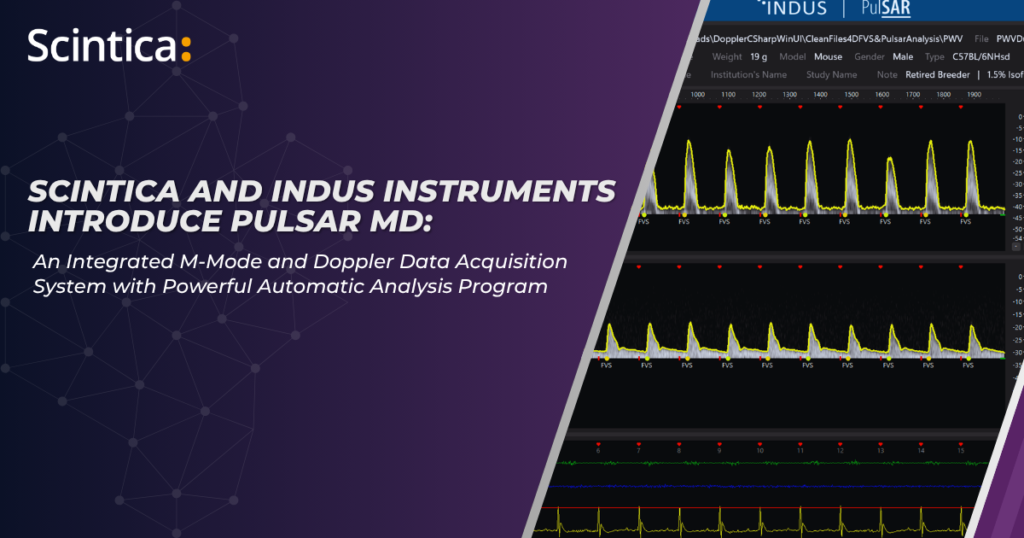
London, Ontario, Canada — July 22, 2026 — Scintica and Indus Instruments are proud to introduce PulSAR MD (Preclinical Ultrasound for Small Animal Research M-Mode and Doppler) system, the next evolution in preclinical hemodynamic assessment. PulSAR MD offers a comprehensive hemodynamic insight platform that combines M-Mode with Color Doppler, Doppler Spectrogram, and fully automated analysis, designed to simplify preclinical vascular assessment through optimized Doppler technology. PulSAR MD is a significant improvement over the previous Doppler Flow Velocity System (DFVS) technology, which has been trusted by preclinical researchers for decades and has contributed to hundreds of publications.
Built for researchers studying vascular dynamics, cardiovascular function, perfusion, and surgical outcomes in small animals, PulSAR MD system utilizes high-speed data acquisition to generate Color Doppler M-Mode scan, Doppler Spectrogram calculation, acquisition of physiological (ECG, Respiration, Blood Pressure, SpO2) signals, all displayed simultaneously with powerful and intuitive software that includes pre-defined algorithms to automatically extract Doppler spectrogram signal parameters. By combining proven Doppler capabilities with Color Doppler M-Mode modern automation and ease of use, PulSAR MD helps researchers acquire high-quality data with greater efficiency, confidence, rigor, and reproducibility.
PulSAR MD expands Doppler technology across a wide range of preclinical applications, including transverse aortic constriction model validation, assessments of arterial stiffness, perfusion metrics such as in the coronary artery or peripheral vessels, organ transplant viability, anastomosis monitoring, vessel and cardiac dimensions.
Research-Validated Hemodynamic Insight
PulSAR MD was developed to support researchers who need reliable, repeatable, and easily accessible tools for measuring dynamic changes in the cardiovascular system. The system enables noninvasive, longitudinal measurements, allowing researchers to follow vascular and cardiac changes over time without adding unnecessary complexity to their workflow.
“A highly versatile and flexible system, PulSAR MD, uses interchangeable pulsed Doppler probes to allow for noninvasive, real-time, dynamic measurements of color Doppler M-Mode, blood flow velocity spectrograms, and physiological signals in small animals, along with game-changing auto-analysis algorithms to facilitate high-throughput phenotyping while maintaining scientific rigor and reproducibility.”
Dr. Anilkumar K. Reddy, Principal Scientist, Indus Instruments
Designed to Simplify Complex Hemodynamic Measurements
PulSAR MD is a dedicated hemodynamic insight platform that combines optimized hardware, including pencil-sized high-frequency probes (10, 20, & 30 MHz), with streamlined workflows and fully automated analytics. The thin probe design with a small footprint supports low-angle alignment with blood flow, thus reducing angle-induced errors that can occur with bulkier ultrasound transducers.
The system includes Color Doppler M-Mode, which combines color flow mapping with motion mode to show the speed, direction, and timing of blood flow in a selected area of interest with simultaneous display of Doppler spectrogram corresponding to selected sample volume within the M-Mode.
“The goal with PulSAR MD was to preserve the sensitivity and utility of Doppler-based vascular assessment while reducing the technical barriers that can slow adoption. With optimized hardware and automated software tools, researchers can evaluate complex hemodynamic signals in a more consistent and efficient way.
Sridhar Madala, Indus Instruments' President
Fully Automated Analysis for Faster, More Consistent Results
PulSAR MD’s automated analysis software allows users to select one of the pre-defined Doppler velocity spectrograms for automatic analysis and generate comprehensive results within seconds. The software calculates vessel dynamics metrics such as velocity, vessel stiffness, pulsatility index, and resistivity index, reducing guesswork and technical barriers that previously required specially trained personnel.
Because each vessel has a unique velocity spectrogram, PulSAR MD includes optimized algorithms for different measurement types, whether users are assessing arteries, veins, or cardiac metrics such as diastolic mitral inflow. This supports more consistent and reproducible analysis across study types.
PulSAR MD allows for real-time acquisition of ECG, and other physiological signals (blood pressure, respiration, etc.), creating more comprehensive datasets for preclinical research.
Hemodynamics Made Simple
PulSAR MD was designed to reduce the learning curve associated with hemodynamic imaging and analysis. With hands-on training from Scintica’s expert team, users can gain proficiency in acquiring and analyzing hemodynamic data in mice, rats, fish, or other species within a short training window.
“PulSAR MD reflects Scintica’s continued commitment to bringing advanced preclinical technologies to researchers in a way that is practical, supported, and scientifically meaningful. By helping simplify complex hemodynamic measurements, PulSAR MD gives labs a more accessible path to high-quality vascular and cardiovascular data.”
Blair Poetschke, Scintica's President
Key Capabilities of PulSAR MD
- Comprehensive hemodynamic insight: PulSAR MD supports a broad range of vascular and cardiovascular applications, including TAC model validation, arterial stiffness, coronary perfusion, peripheral perfusion, organ transplant viability, anastomosis monitoring, vessel and cardiac dimension measurement, and assessment of cardiac output and function.
- Optimized high-frequency Doppler hardware: The system includes pencil-sized high-frequency pulsed Doppler probes and hardware designed with simplicity and usability in mind.
- Improved Doppler alignment: The small footprint probe design supports proper alignment with blood flow, helping reduce angle-induced errors commonly associated with bulkier ultrasound transducers.
- Color Doppler M-Mode: PulSAR MD combines color flow mapping with motion mode to provide insight into the speed, direction, and timing of blood flow in the selected icepick view of interest. Doppler spectrogram sampled from any location along the icepick view is displayed.

- Fully automated analysis: The software rapidly calculates comprehensive vessel dynamics parameters, including velocity, vessel stiffness metrics, pulsatility index, and resistivity index.

- Vessel-specific algorithms: Optimized algorithms support analysis across arteries, veins, and cardiac metrics, helping improve consistency and reproducibility.

- Real-time signal import: Users can import signals such as ECG, blood pressure, respiration, and other physiological parameters to build more complete datasets.

About Scintica
Scintica provides a one-stop location for researchers looking to equip their labs with high-quality scientific instrumentation to support preclinical and translational research in cardiovascular science, oncology, neurology, and niche research fields. With a team of expert scientists and offices across North America and Europe, Scintica serves as a trusted partner for researchers worldwide, with a focus on preclinical imaging systems, physiology and monitoring equipment, live-cell and tissue imaging, scientific support, and CRO services.
About Indus Instruments
Indus Instruments was founded in 1992 to address a gap in preclinical research by engineering non-invasive biomedical equipment optimized for primary laboratory animal models, including mice and rats. In addition to pre-clinical research technologies, Indus offers custom engineering R&D, turnkey product design, and contract manufacturing for sectors including biomedical and energy applications.
Contact Us
Scintica Instrumentation
www.scintica.com
info@scintica.com
📞 Canada: +1 (519) 914-5495
📞 USA: +1 (832) 548-0895
📞 Europe: +31 43 808 0014